
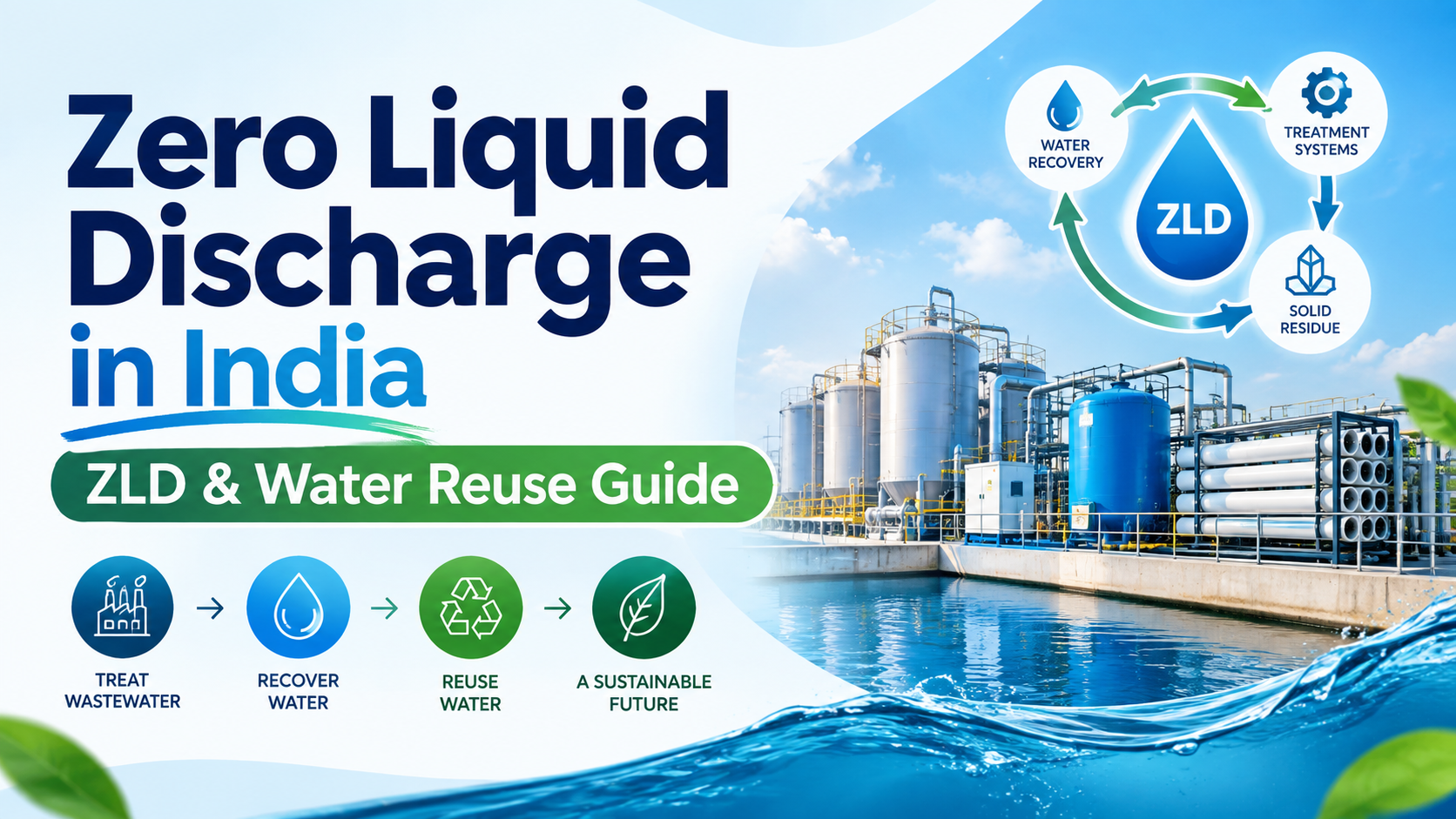
Water-intensive industries are increasingly looking beyond conventional wastewater treatment and focusing on water recovery, recycling and reuse. With growing pressure on freshwater resources, industries need treatment systems that can reduce wastewater discharge while recovering as much usable water as technically and economically possible.
This is where Zero Liquid Discharge (ZLD) in India is becoming an important approach for industrial wastewater management. A ZLD system is designed to recover treated water from industrial effluent and minimize or eliminate liquid discharge from the facility.
What Is Zero Liquid Discharge?
Zero Liquid Discharge is an advanced wastewater-management approach in which industrial effluent is treated, water is recovered for reuse, and the remaining concentrated contaminants are converted into a solid residue.
Unlike conventional treatment systems that may discharge treated effluent after meeting applicable requirements, a ZLD system focuses on maximum practical water recovery and reduction of liquid waste leaving the facility.
The exact ZLD configuration depends on the industry, wastewater characteristics, flow rate, TDS levels, treatment objectives and water-reuse requirements.
Why Is ZLD Becoming Important in India?
Freshwater availability, industrial water demand and wastewater-management requirements are encouraging industries to look at recycling and reuse more seriously. India's Ministry of Jal Shakti has highlighted treated-water reuse as an important part of sustainable water management, including applications in industrial processes and other non-potable uses.
ZLD can be particularly relevant for industries where wastewater contains high dissolved solids or where reducing liquid discharge and maximizing water recovery are important operational objectives.
The approach can help industries work toward:
Higher wastewater recovery
Reduced freshwater dependency
Recycling of suitable treated water
Better management of concentrated wastewater
Reduced liquid discharge
More sustainable industrial water management
How Does a Zero Liquid Discharge System Work?
A ZLD plant generally consists of multiple treatment and recovery stages rather than one standalone process. The treatment train is selected according to the characteristics of the industrial effluent.
A typical approach can include:
Primary Treatment → Biological/Chemical Treatment → Filtration → RO → Concentration → Evaporation → Crystallization → Solid Residue
Not every project requires exactly the same sequence. The final configuration should be developed after evaluating the wastewater and the desired recovery level.
1. Effluent Treatment
The incoming industrial wastewater is first treated to remove contaminants that could interfere with downstream recovery systems. Depending on the wastewater, this can involve physical, chemical and biological treatment processes.
2. Membrane-Based Recovery
Reverse osmosis can be incorporated where suitable to recover a significant portion of water while concentrating the remaining dissolved solids.
3. Concentrate Management
The RO reject or other concentrated streams require further treatment in a ZLD system. Evaporation technologies can reduce the remaining liquid volume and recover additional water.
4. Solid Residue
At the final stage, the concentrated salts and other residual materials can be converted into a solid form for appropriate handling and disposal according to applicable requirements.
Role of RO and Evaporation in ZLD
Reverse osmosis and evaporation can play important roles in industrial water-recovery systems. RO can separate water from dissolved contaminants and produce a recovered water stream while generating a concentrated reject stream.
Evaporation can then be used to further concentrate the remaining stream. Multi-Effect Evaporators (MEE) are among the technologies used in industrial water-recovery applications, including projects implementing ZLD systems.
The appropriate combination depends on wastewater characteristics, recovery targets, energy considerations and the overall economics of the project.
Which Industries Can Consider ZLD?
ZLD can be considered for industries where wastewater recycling, high water recovery or minimization of liquid discharge is a significant requirement.
Potential applications include:
Textile and dyeing industries
Pharmaceutical industries
Chemical industries
Food-processing industries
Manufacturing facilities
Power and other water-intensive industries
The suitability of ZLD should always be evaluated on a project-by-project basis because wastewater characteristics can vary significantly even within the same industry.
Key Factors Before Installing a ZLD Plant
A ZLD system requires careful planning because it can involve several treatment stages and energy-intensive processes.
Businesses should evaluate:
Wastewater Characteristics: pH, TDS, COD, BOD, suspended solids, chemicals and other relevant parameters.
Flow Rate: Average and peak wastewater generation influence plant sizing.
Water-Recovery Target: The required percentage of water recovery affects the treatment configuration.
Energy Requirements: Thermal concentration and evaporation can significantly influence operating requirements.
Space Availability: Multiple treatment stages require appropriate plant layout and maintenance access.
Residue Management: Concentrated salts and solids need suitable handling and disposal arrangements.
ZLD and Industrial Water Reuse
One of the major advantages of ZLD is that wastewater can be viewed as a potential water resource rather than simply a waste stream. Where the recovered water meets the required quality, it may be reused for suitable industrial applications.
Indian government initiatives are increasingly promoting the safe reuse of treated wastewater to reduce freshwater dependence and support water security.
This makes ZLD particularly relevant for businesses looking to develop a more circular approach to industrial water management.
Challenges of Zero Liquid Discharge
ZLD can provide substantial water-recovery benefits, but it is not automatically the right solution for every industry.
Potential challenges include:
Higher capital investment
Energy consumption
Complex treatment configuration
Regular equipment maintenance
Concentrate and residue management
Requirement for skilled operation
Higher operating costs in certain applications
For this reason, industries should assess the technical and economic feasibility of ZLD before selecting the system.
Neel Guard Aqua Systems for Industrial Water Treatment
Neel Guard Aqua Systems provides water and wastewater treatment solutions for industrial, commercial and institutional requirements. Established in 2011, the company focuses on application-based treatment solutions according to wastewater characteristics, treatment capacity, site conditions and water-reuse requirements.
For industries evaluating Zero Liquid Discharge in India, the treatment approach should be developed around the actual wastewater profile and desired recovery objectives. A properly planned system can integrate effluent treatment, water recovery and concentrate management into a coordinated wastewater-management strategy.
Moving Towards a Circular Water Management Approach
Zero Liquid Discharge represents a shift from treating wastewater only for disposal toward recovering and reusing water wherever technically and economically feasible.
As Indian industries look for ways to reduce freshwater consumption and improve wastewater management, ZLD can become an important consideration for suitable high-water-use applications. Recent government-supported industrial projects are also implementing ZLD and MEE-based approaches for wastewater treatment and water recovery.
For industries considering ZLD, the most important step is to start with a detailed assessment of wastewater characteristics, flow, recovery requirements, energy considerations and residue management. This helps determine whether ZLD is appropriate and what treatment configuration would best suit the facility.
Powered by Froala Editor